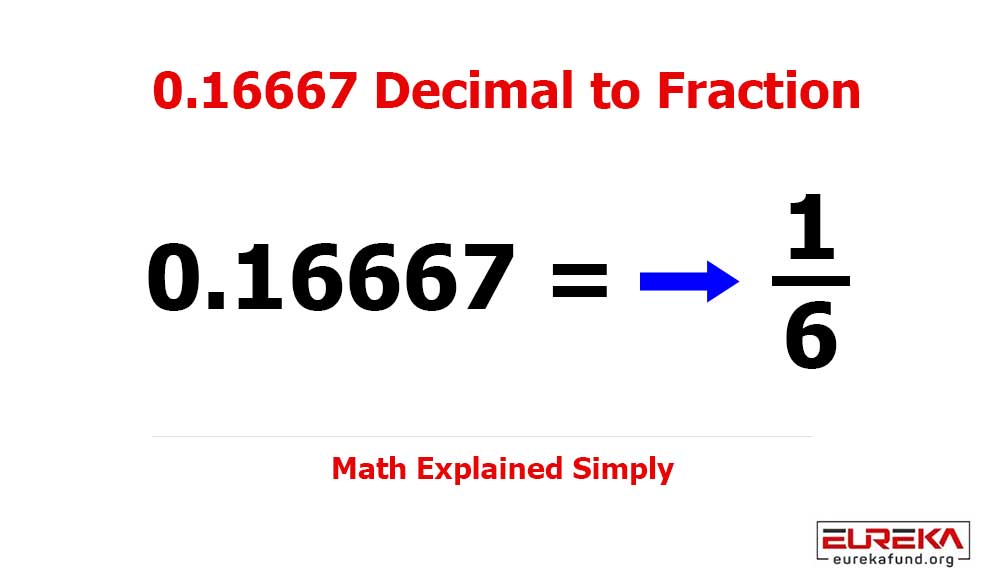
Decimals like 0.16667 appear frequently in calculators, measurements, statistics, and percentage-based calculations. At first glance, this decimal looks like an ordinary terminating number, but it actually represents a rounded repeating decimal.
So the important question is:
What is 0.16667 as a fraction, and what is its exact value?
In this article, we’ll explain:
- Whether 0.16667 is exact or rounded
- Its correct fractional form
- Why repeating decimals matter
- How to verify the result
- Where this conversion is commonly used
Is 0.16667 an Exact Decimal?
No. Just like the example of 1.66666,
0.16667 is not exact — it is a rounded approximation.
The true decimal value behind 0.16667 is:
- 0.166666… (repeating)
This repeating decimal is commonly rounded to 0.16667 for convenience in calculators, spreadsheets, and reports.
Understanding the Decimal 0.166666…
The repeating decimal 0.166666… means:
- The digit 6 repeats forever
- There is no final digit
This repeating pattern corresponds to a well-known fraction.
Converting 0.16667 into a Fraction
Step 1: Identify the Repeating Pattern
The decimal 0.166666… is a classic repeating decimal.
Mathematically:
- 0.166666… = 1 ÷ 6
Step 2: Write the Exact Fraction
Since the repeating decimal equals one divided by six:
- 0.166666… = 1/6
Because 0.16667 is simply a rounded form of this repeating decimal, the correct fraction is:
- 1/6
✅ Final Answer
0.16667 as a fraction = 1/6
Why 1/6 Is the Correct Fraction
Let’s verify it:
- 1 ÷ 6 = 0.166666…
- Rounded to five decimal places → 0.16667
This confirms that 1/6 is the exact fractional representation.
Verification Methods
Decimal Verification
- 1 ÷ 6 = 0.166666…
- Rounded → 0.16667
✔ Match confirmed
Fraction Consistency
If you multiply 0.16667 by 6, you get approximately 1, confirming it’s a rounded value of 1/6.
Is 0.16667 a Rational Number?
Yes.
All repeating decimals are rational numbers because they can be written as fractions.
Since:
- 0.166666… = 1/6
It is rational.
Real-Life Uses of 0.16667 as a Fraction
📊 Percentages
- 0.16667 ≈ 16.667%
- Represents 1 out of 6 parts
📏 Measurements
- One-sixth of a unit
- Used in ratios, spacing, and proportional layouts
🧮 Mathematics & Education
- Appears in division problems
- Common example in repeating decimals lessons
🧪 Science & Data
- Rounded values used in reports
- Exact fractions preferred in formulas
Common Mistakes to Avoid
- ❌ Treating 0.16667 as an exact decimal
- ❌ Writing 16667/100000 as the final fraction
- ❌ Ignoring the repeating nature of the decimal
- ❌ Forgetting rounding effects
Always check whether a decimal repeats before converting.
Quick Comparison Table
| Decimal | Fraction |
| 0.1 | 1/10 |
| 0.125 | 1/8 |
| 0.16667 | 1/6 |
| 0.2 | 1/5 |
| 0.25 | 1/4 |
FAQs: 0.16667 as a Fraction
What is 0.16667 as a fraction?
0.16667 as a fraction is 1/6.
Is 0.16667 exact or rounded?
It is rounded. The exact value is 0.166666…
Why does 0.16667 equal 1/6?
Because dividing 1 by 6 produces a repeating decimal that rounds to 0.16667.
Can 0.16667 be written as a terminating fraction?
No. Its exact decimal form repeats infinitely.
Is 1/6 better than 0.16667?
Yes. Fractions preserve exact values, while decimals may lose precision.
Final Answer Box
0.16667 as a Fraction (Exact Value)
1/6
Key Takeaway
To convert 0.16667 into a fraction:
- Recognize it as a rounded repeating decimal
- Identify the repeating pattern (0.166666…)
- Match it to the exact fraction 1/6
- Use the fraction for accuracy
Understanding repeating decimals helps prevent rounding errors and ensures precision in math, science, finance, and real-world calculations.
